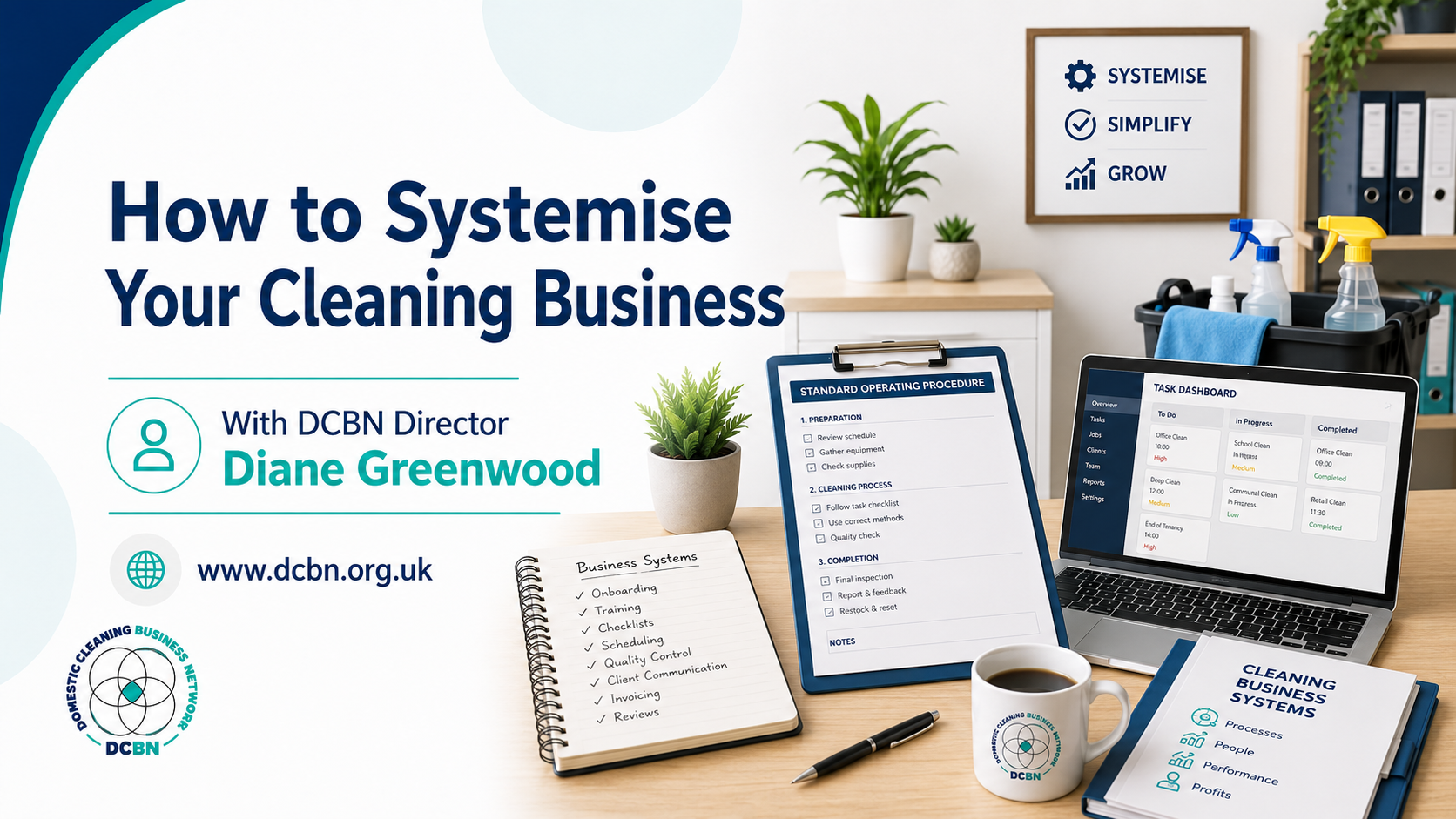


Learn how to systemise your cleaning business, reduce repeated admin, improve standards and create a company that is less dependent on you.
Systemisation can sound corporate or impersonal, particularly in a domestic cleaning business built around relationships. In reality, good systems make it easier to deliver a reliable and personal service. They reduce confusion, protect standards and stop the business depending on what happens to be in the owner’s head.
What does it mean to systemise a cleaning business?
A system is simply an agreed way of completing a recurring activity. It might be:
- A checklist
- A template
- A written process
- A short training video
- An automated email
- A form
- A set of instructions
- A clear allocation of responsibility
You already have systems, even if you have never formally created them. Perhaps you always send a particular message when a client cancels. Maybe you explain the same cleaning method during every new starter’s first week. The problem is that informal systems are difficult to delegate, measure or repeat consistently. Systemisation takes what you already do and turns it into something other people can follow.
Signs that your business needs better systems
You may need to systemise if:
- Team members regularly ask the same questions.
- Clients receive different information depending on who replies.
- Important tasks are forgotten when you are busy.
- Training depends entirely on you.
- Standards vary between cleaners.
- You struggle to take uninterrupted time off.
- New employees take too long to become confident.
- Mistakes lead to blame because responsibilities are unclear.
- Documents are scattered across emails, folders and devices.
- You repeatedly rewrite the same messages.
These problems are often treated as individual mistakes. Sometimes they are. But when the same type of mistake happens repeatedly, the process usually needs attention too.
Start with the areas causing the most disruption
You do not need to document the entire business at once. Trying to create a huge operations manual in one weekend usually leads to frustration and an unfinished folder nobody uses. Start with repeated tasks that create the most risk, stress or wasted time. Good starting points often include:
- Handling new enquiries
- Completing quotes
- Onboarding new clients
- Managing keys and alarm details
- Reporting sickness
- Arranging cover
- Training new cleaners
- Completing quality checks
- Responding to complaints
- Managing cancellations
- Processing leavers
- Requesting reviews
Choose one process and improve it before moving to the next.
Map what happens now
Before creating a new system, write down how the task currently works. For a new client enquiry, that might be:
- An enquiry arrives through the website.
- The owner replies.
- Information is gathered by email.
- A home visit is arranged.
- A quote is prepared.
- The client accepts.
- Payment information is requested.
- The first clean is booked.
- The team receives instructions.
Now look for weaknesses. What happens if the owner is unavailable? Where is the information stored? Is there a standard response time? Does every client receive the same terms? Who checks that payment details have been completed? A process map does not need to be complicated. Its purpose is to expose gaps and unnecessary steps.
Create standard operating procedures people will actually use
A standard operating procedure, often shortened to SOP, explains how a task should be completed. It does not need to be a ten-page document. For many cleaning-business activities, a one-page checklist, flowchart or short video is more useful. A good SOP should explain:
- The purpose of the task
- Who is responsible
- When it should happen
- The steps involved
- Where information is recorded
- What to do if something goes wrong
Use straightforward language. Include photographs or screenshots where they make the process clearer. Most importantly, involve the people who actually complete the task. They may notice practical problems that are invisible from the office.
Systemisation is not the same as automation
The two are related, but they are not identical. A system is the agreed process. Automation uses technology to complete part of that process. For example, your system may require every new client to receive a welcome email, terms and payment instructions. Automation could send those documents after the client is marked as booked in your software. Automating a poor process simply allows the confusion to happen faster. Define the process first, then decide which parts technology can support. Useful cleaning-business automations might include:
- Enquiry acknowledgements
- Quote follow-ups
- Appointment reminders
- Client welcome messages
- Review requests
- Staff onboarding information
- Recurring invoices
- Payment reminders
- Internal task notifications
Automation should reduce repetitive work without making the client feel as though they are dealing with a machine.
Protect the personal touch
Some business owners resist systems because they fear every client will receive a cold, identical service. But consistency and personalisation can work together. A welcome email can be standardised while still including the client’s name and details. A complaint process can be consistent while the conversation remains empathetic. A cleaner can follow a checklist while still noticing what matters to the individual client. The system provides the reliable foundation. Your people provide the human connection. In fact, good systems often create more time for personal service because the owner is no longer buried in repetitive administration.
Use systems to improve training and quality
Telling a cleaner to “clean it properly” is not a training system. Standards need to be explained, demonstrated and checked. Create clear guidance covering:
- The order in which rooms or tasks should be approached
- Products and equipment
- Safety procedures
- What is included in each service
- Tasks that require client approval
- Finishing standards
- Reporting damage or concerns
- Photographs or evidence where appropriate
- Quality-control checks
This protects the cleaner as well as the business. They know what is expected and have something to refer back to. When quality issues arise, you can identify whether the problem is a failure to follow the process or whether the process itself needs improvement.
Give people responsibility, not just tasks
A common delegation mistake is giving somebody a task while keeping all decision-making authority. For example, you ask a manager to handle sickness cover, but every change still requires your approval. You remain the bottleneck. A stronger system defines:
- What the person can decide
- What budget or limits apply
- When they need to escalate
- What information must be recorded
- How success will be measured
This may feel uncomfortable at first. People will sometimes make decisions differently from you. The aim is not to create a team of people who copy every personal preference you have. It is to create a business that operates within clear standards without requiring your involvement in every detail.
Keep your systems alive
A system is not finished forever. Services change, software changes and the team discovers better ways of working. Schedule regular reviews. Ask:
- Is this process still accurate?
- Is anybody actually using it?
- Where are mistakes still occurring?
- Could any steps be removed?
- Does responsibility sit with the right person?
- Could technology make it easier?
- Does the process still protect the client and the business?
Encourage your team to flag outdated or impractical guidance. The strongest systems evolve with the company.
Build a business that works beyond you
Systemisation is not about removing the owner from the business completely. It is about giving you a choice. You should be able to take a holiday, attend an appointment or spend time working on future plans without routine operations immediately falling apart. DCBN members have access to templates, documents, training and masterclasses covering systems, client journeys, team management, quality control, onboarding and business operations. The weekly masterminds also give members the opportunity to discuss practical challenges with other cleaning business owners. Instead of starting every process with a blank page, you can learn from systems that are already working elsewhere in the industry. Your experience and judgement will always be valuable. But they become far more powerful when they are turned into clear processes that help the whole business perform well.
Next Steps
Build a cleaning business that does not rely on you remembering and managing everything. Join the DCBN for practical templates, training, 121 mentoring and support created specifically for domestic cleaning business owners.
Also check out this fantastic ebook in our online shop: Clean Profits – Systemise your way to a better cleaning business
Cleaning business systems
Cleaning company processes
Cleaning business SOPs
How to run a cleaning business without doing everything
Cleaning staff procedures